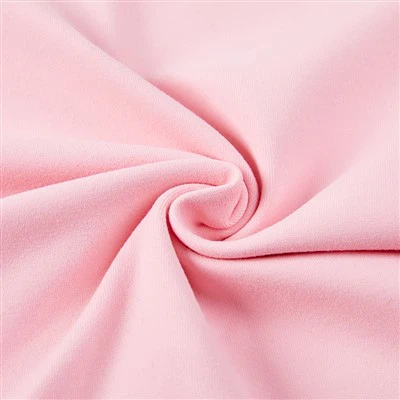
Hey there! As a supplier of Swimsuit Lining Fabric, I often get asked about how to check the elasticity recovery of this kind of fabric. It's a crucial aspect because it directly impacts the quality and performance of the swimsuits. So, in this blog, I'm gonna share some practical ways to do that.


First off, let's understand why elasticity recovery matters. A swimsuit lining fabric with good elasticity recovery can maintain its shape even after repeated stretching. This means the swimsuit will fit well over time, providing comfort and support to the wearer. No one wants a swimsuit that loses its shape after a few dips in the pool, right?
One of the simplest ways to check elasticity recovery is the manual stretch - and - release test. You just take a small sample of the Swimsuit Lining Fabric. Make sure it's big enough to hold firmly, like a piece about 4 - 5 inches square. Hold the fabric at two opposite edges and gently stretch it. Don't go overboard; just stretch it to about twice its original length. Then, let go of the fabric quickly.
Watch how the fabric behaves. If it snaps back to its original shape almost immediately, that's a great sign. It indicates good elasticity recovery. But if it takes a long time to return to its original size or doesn't fully recover, leaving some wrinkles or a stretched - out look, then the elasticity recovery might not be up to par.
Another method is the cyclic stretching test. This one is a bit more involved but gives you a better idea of how the fabric will perform over time. You'll need a simple setup, like a couple of clamps and a ruler. Clamp one end of the fabric sample firmly and attach a small weight to the other end. The weight should be heavy enough to stretch the fabric but not so heavy that it tears it.
Mark the original length of the fabric on the ruler. Then, start stretching the fabric by adding more weights in small increments. After each increment, let the fabric rest for about 10 - 15 seconds and measure the length. Keep doing this until you've stretched the fabric to a certain pre - determined level, say 150% of its original length.
Once you've reached that level, start removing the weights one by one. After removing each weight, wait for 10 - 15 seconds and measure the length again. The difference between the final length and the original length is an indication of the elasticity recovery. A smaller difference means better recovery.
Now, let's talk about the role of fabric composition in elasticity recovery. Different fibers have different elastic properties. For example, spandex is well - known for its high elasticity and excellent recovery. Fabrics that contain a good percentage of spandex are likely to have better elasticity recovery. On the other hand, natural fibers like cotton usually have less elasticity and may not recover as well.
As a supplier, I always make sure to source high - quality fibers for our Swimsuit Lining Fabric. We also conduct regular quality checks to ensure that the fabric meets the required standards of elasticity recovery.
When it comes to choosing the right swimsuit lining fabric for your brand, you need to consider the end - user's needs. If you're targeting athletes or people who are very active in the water, you'll want a fabric with top - notch elasticity recovery. This will ensure that the swimsuit stays in place and provides the necessary support during intense activities.
For more casual swimwear, you might have a bit more flexibility in terms of the elasticity recovery requirements. However, it's still important to offer a product that maintains its shape and fit.
If you're in the market for swimwear fabrics by the metre, we've got a great selection of Swimwear Fabric By The Metre. These fabrics are not only high - quality but also come in a variety of colors and patterns to suit your design needs.
And if you're into sustainable fashion, we also offer Sustainable Swimwear Fabric. We believe in being eco - friendly without compromising on quality. Our sustainable fabrics are made from recycled materials and are produced using environmentally friendly processes.
So, if you're interested in our swimsuit lining fabrics or any of our other products, don't hesitate to reach out. Whether you're a small local brand or a large international company, we're here to work with you. We can provide you with samples, discuss your specific requirements, and find the perfect fabric solution for your swimwear line.
In conclusion, checking the elasticity recovery of swimsuit lining fabric is essential for ensuring the quality of your swimsuits. By using simple tests like the manual stretch - and - release test or the cyclic stretching test, you can easily assess the fabric's performance. And as a trusted supplier, we're dedicated to providing you with the best - quality fabrics that meet your needs.
References:
- Textile Testing Handbook, various editions
- Research papers on swimwear fabric properties